Discovering Data Centers
Season 2, Episode 4
Season 2, Episode 4
“How are data centers powered sustainably?”
Explore how Google’s data centers are powered sustainably, especially in a world confronting the threat of climate change.

Watch
Link to Youtube Video (visible only when JS is disabled)
How are Google data centers powered sustainably?
[00:07] How does Google design a data center that can support millions of connected end points and requests simultaneously? At Google, it took 18 years of work downloading an entire web
[00:18] and index. Back in the early days, we ran on a limited number of high-end traditional enterprise servers and storage
[00:25] in a shared facility, leading to what's now one of the world's largest computing systems made up of multi-acre sized data centers.
[00:34] A data center consists of compute, storage, networking,
[00:37] and power and cooling infrastructure in order to handle demand. Think of all the parts like building blocks that talk to each other. Red blocks are server halls with compute and networking.
[00:48] Green are power supply. And blue are cooling infrastructure. Let's start with red blocks-- server rooms. Chips comprise processing and memory in a server, which also includes hard drives or storage.
[01:00] These servers are consolidated into racks and positioned into rows. Thanks to Moore's Law, we can process more information than ever before in a smaller computing unit.
[01:11] Today, that means a single data center building with thousands of server racks holding thousands of gigabytes of data. All of this is possible through our green blocks-- power supply. An electric system
[01:29] feeds into the building and provides a steady stream of electrons flowing to servers. And just in case our electric system goes out, we employ a backup energy source to provide redundant power
[01:35] supplies to servers. A mechanical system also feeds into the building to help remove heat from hard working servers. These high-density servers generate a lot of heat. But by continuously raising
[01:51] the operating temperature in our data centers as computing technology allows, we use less energy. And that leads us to our next crucial piece-- our blue blocks-- cooling. Hot/cold aisle is a
[02:11] server aisle layout that increases the effectiveness of the cooling system by managing airflow. Server racks are lined up with cold air facing one way and hot exhaust facing the other.
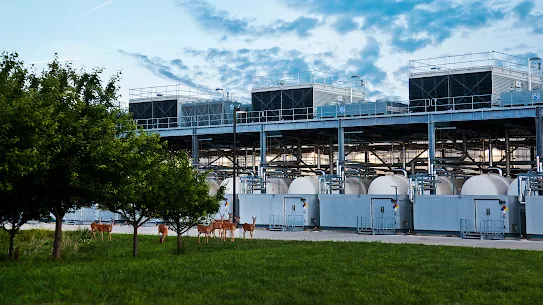
[02:21] We distribute chilled water through an array of pipes over to fan coil units that service the racks and help disperse heat. As the water is warmed by the servers, it's moved through
[02:26] an array of pipes, then to a cooling tower for evaporative cooling. Using blocks as a framework, designing a data center
[02:29] becomes easier. The real challenge-- massive scale and the core principles
[02:34] behind running a data center. More on that next on Discovering Data Centers.
[02:39] If you want to learn more, check out google.com/datacenters.
[02:43] [MUSIC PLAYING]